.png)

Composite vs Timber Doors: An Architectural Guide to Premium Entrances
- View Glazing

- Aug 4
- 12 min read
Can a front door truly offer the timeless warmth of natural oak without the inevitable battle against the South West's coastal winds and damp winters? When debating composite vs timber doors, it's natural to feel torn between the authentic character of wood and the resilient, low-maintenance promise of modern engineering. You deserve a solution that enhances your property's architectural integrity while matching the thermal performance of high-end glazing systems.
Many homeowners worry that choosing durability means sacrificing aesthetics for a 'plastic' finish, or that opting for heritage timber means accepting future rot and warping. This guide provides a professional comparison to help you address these concerns with confidence. We'll examine the latest PAS 24:2022 security standards, the 2026 Building Regulations for U-values, and how to select a premium entrance that remains beautiful and functional for decades.
Table of Contents
Defining the Standards: Timber vs Composite Entrances
Choosing a front door involves more than picking a colour or a handle. It's a decision about structural integrity and how a material responds to the specific environmental pressures of the South West. When evaluating composite vs timber doors, the distinction lies in how the core and surface are manufactured to balance beauty with long-term performance.
Premium entrances are defined by their physical presence. A high-quality door should offer a reassuring weight and solid acoustics; a dull thud rather than a hollow ring when closed. This density isn't just for feel. It indicates the thickness of the internal components and the quality of the seals, which directly impacts security and thermal retention. Architects now frequently specify these systems as integral parts of a building's envelope rather than mere decorative additions.
The Craftsmanship of Modern Timber
The timber doors of the past often suffered from seasonal movement, leading to sticking frames or draughty gaps. Modern craftsmanship has solved this by moving away from single solid planks towards engineered timber. This process involves layering wood grains in opposing directions to neutralise internal stresses, effectively preventing the warping and twisting once common in oak or pine installations. For those prioritising a traditional aesthetic, Rationel windows offer a benchmark for this level of sustainable timber engineering.
Sustainability remains a core pillar of the timber choice. Using FSC-certified wood ensures that your entrance acts as a natural carbon sink, providing an environmentally responsible solution that can last for decades if properly maintained. It's a choice that respects the heritage of Bristol’s Victorian and Georgian terraces whilst meeting modern performance demands.
The Engineering of a Composite Door
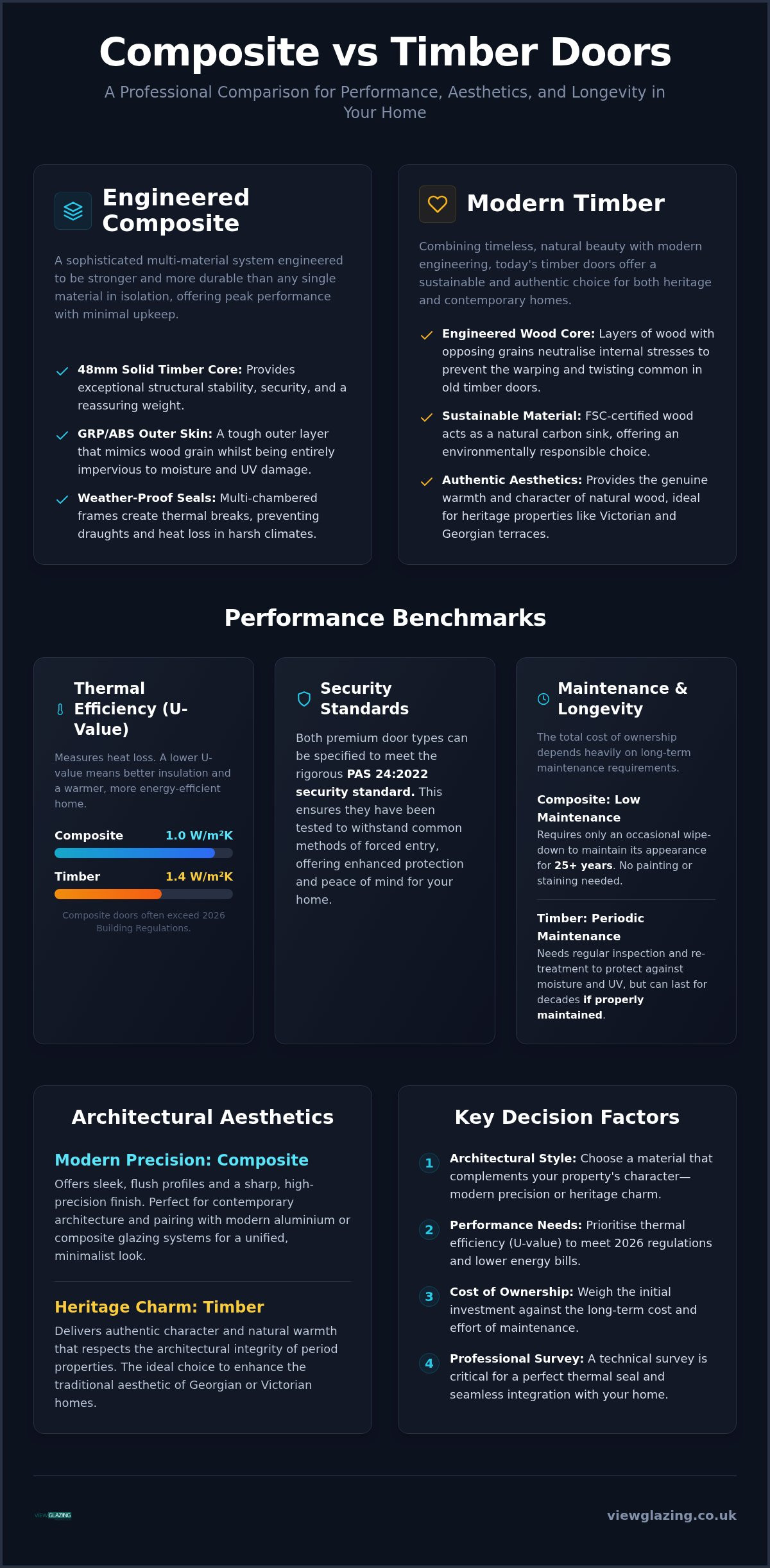
A composite door is a sophisticated multi-material component. To understand why these have become so popular, it helps to look at what are composite materials in a broader sense; they are engineered to be stronger and more durable than any single material used in isolation. Most premium composite doors feature a 48mm solid timber core, which is significantly thicker than standard alternatives, providing exceptional structural stability and security.
This core is typically encased in a Glass Reinforced Plastic (GRP) or ABS skin. These outer layers are designed to mimic the natural grain of wood whilst remaining entirely impervious to moisture and UV damage. In contemporary South West architecture, we're seeing a strong move towards flush, minimalist designs. These sleek profiles offer a clean aesthetic that pairs perfectly with modern glazing, providing a sharp, high-precision finish that requires nothing more than an occasional wipe down to maintain its appearance for 25 years or more.
Performance Benchmarks: Security, Thermal Efficiency, and Maintenance
Performance isn't just about laboratory tests; it's about how an entrance withstands 25 years of British weather. When comparing composite vs timber doors, the primary technical divergence is found in thermal transmittance and the frequency of required upkeep. While timber offers a natural insulation that has served homes for centuries, modern composite units are specifically engineered to exceed current security and thermal performance standards.
Thermal Performance in the South West Climate
A front door is often the weakest link in a home's thermal envelope. To achieve a truly high-performance home, an entrance must complement other installations like energy efficient windows Bristol. U-values represent the measure of thermal transmittance, indicating how much heat is lost through a door's surface, which is a critical factor for 2026 building compliance. Modern composite doors often lead this category, achieving U-values as low as 1.0 W/m²K, whereas traditional timber often sits closer to the 1.4 W/m²K limit for existing dwellings.
Multi-chambered frames play a vital role in this efficiency. In exposed Cotswold locations or coastal areas near Bristol, these internal chambers act as thermal breaks to prevent cold bridging. This engineering ensures that even when the wind howls against the exterior, the interior remains draught-free and warm.
Advanced Security and Locking Systems
Security is a non-negotiable priority. For 2026, the benchmark remains PAS 24:2022, a rigorous testing standard that ensures an entrance can resist persistent physical attacks. Architectural-grade doors now feature multi-point locking systems as standard, engaging several bolts into the frame simultaneously. Composite skins, particularly those with a 48mm solid core, offer a level of impact resistance that traditional thin timber panels struggle to match. You can also integrate smart-lock technology seamlessly into these high-performance frames, ensuring modern convenience without compromising the door's aesthetic integrity.
Maintenance is where the two materials diverge most sharply. Timber is a living material. It requires annual oiling or painting to prevent the ingress of moisture, which can lead to rot or swelling. If you commit to this cycle, a high-quality timber door can last indefinitely. Conversely, a premium composite door is designed for a lifespan of 30 years or more with almost zero maintenance. A simple wipe with a damp cloth is usually enough to keep the GRP skin looking pristine. If you're unsure which maintenance profile suits your lifestyle, speak with our technical team for a tailored recommendation.
Architectural Aesthetics: Heritage Charm vs Modern Precision
The entrance door serves as the architectural signature of a home. In cities like Bath and Bristol, where property values are significantly influenced by historical context and kerb appeal, selecting the right material is a strategic investment. The choice between composite vs timber doors often hinges on whether you aim to replicate a heritage look or establish a crisp, contemporary identity that stands out for its precision.
A common mistake in home renovation is treating the front door as an isolated purchase. To achieve true aesthetic harmony, the entrance must speak the same design language as the rest of the property's envelope. This often involves colour-matching frames with high-performance systems like VELFAC windows Bristol. By synchronising the RAL colours and profile depths across your glazing, you create a unified facade that feels intentional and high-end. In recent years, we've seen a dominant shift towards Anthracite Grey and Slate amongst contemporary South West developments, colours that provide a sophisticated, industrial-inspired edge whilst remaining versatile enough for varied brickwork.
Traditional Styles for Period Properties
For Georgian and Victorian homes in Salisbury and across Wiltshire, authentic timber is frequently the only material that satisfies local planning requirements for period refurbishments. These properties demand the depth of shadow lines and the tactile grain that only real wood provides. High-quality hardware is equally vital; aged brass knockers and traditional letterplates complete the heritage narrative. When refurbishing these classic homes, timber windows Bristol (specifically Rationel systems) provide the natural partner for a timber entrance, ensuring the entire elevation respects the building's history and architectural integrity.
Contemporary Flush Designs for New Builds
Modern extensions and 'Grand Design' style projects in the South West are increasingly moving towards minimalist, flush aesthetics. These designs favour clean lines and hidden hinges, creating a sleek profile that complements large-format glazing. You can utilise oversized pull handles and integrated glazing panels to create a bespoke focal point that feels both secure and inviting. Maintaining a consistent architectural language is essential, ensuring that even the most minimalist designs function as high security entrance doors Bristol without losing their visual elegance. When evaluating composite vs timber doors for a new build, the decision often rests on which material best achieves that sharp, high-precision finish that modern architecture demands.
The Economics of Longevity: Investment and Environmental Impact
When evaluating the financial commitment of a new entrance, the initial purchase price is only one part of the equation. A strategic investment considers the total cost of ownership over a 25 or 30-year period. In the debate of composite vs timber doors, the economic winner often depends on your willingness to invest time versus capital. While timber may require professional repainting or re-oiling every three to five years to prevent weather damage, a premium composite door remains structurally inert, requiring no such recurring expenditure.
Security specifications also play a direct role in your household finances. Insurers in the South West increasingly look for PAS 24:2022 certification as a baseline for coverage. Choosing a door that exceeds these standards doesn't just provide peace of mind; it can actively lower your annual home insurance premiums. By installing a door that is recognised as a high-security component, you demonstrate a commitment to risk reduction that many providers reward with more competitive rates.
Sustainability and the 'Buy Once' Philosophy
Environmental responsibility is no longer a niche concern; it's a fundamental requirement for modern residential architecture. High-performance glazing and doors are essential tools for meeting UK Net Zero targets, as they drastically reduce the energy required to heat a home. The 'buy once' philosophy suggests that the most sustainable product is the one you don't have to replace for three decades. FSC-certified timber doors act as a natural carbon sink by sequestering carbon dioxide throughout their service life. Conversely, the longevity of a composite door reduces the environmental impact associated with manufacturing and transporting replacement units every ten years, making both choices viable from different ecological perspectives.
Buyer Perception and Property Valuation
The front door is the psychological handshake of a property. For potential buyers in Bristol and Bath, the tactile experience of opening a heavy, high-quality door creates an immediate impression of structural integrity. It signals that the refurbishment has been handled with care and that no corners have been cut. This perceived value often translates into a higher final sale price, as the entrance serves as a visual shorthand for the quality of the entire home. To ensure your choices align with your wider architectural goals, it's often beneficial to consult a glazing project management specialist who can help you maximise your return on investment.
Selecting the right material is a balance of immediate desire and long-term practicality. Whether you're drawn to the heritage warmth of wood or the engineered resilience of modern skins, your choice will define your home's performance for a generation. If you're ready to discuss which specification best serves your property’s unique requirements, contact our technical consultants today for expert guidance.
Specification and Installation: Why the Right Partner Matters
A high-performance entrance is a complex structural assembly. Its success depends entirely on the precision of the installation and the quality of the interface with your property’s fabric. When comparing composite vs timber doors, the technical survey is the stage where architectural vision meets engineering reality. Unlike mass-market retail products, architectural-grade systems require a deep understanding of how different materials behave under the South West's specific environmental pressures.
In areas like Bath and Bristol, we often work with challenging substrates such as Bath stone, traditional brickwork, or modern render. Each material has unique expansion and contraction rates. A standard 'one size fits all' installation often fails to account for these movements, leading to cold bridging or compromised seals. Our approach focuses on managing these interfaces with technical precision; we ensure that the door frame remains perfectly plumb and the thermal break is maintained across the entire aperture.
The View Glazing Survey and Specification Process
Our journey begins with a comprehensive technical survey that moves far beyond simple measurements. We produce detailed technical drawings that account for floor levels, threshold heights, and drainage requirements. This meticulous planning ensures full compliance with Building Regulations, specifically Document Q for security and Document L for thermal performance. Our bespoke survey process avoids common pitfalls in older South West properties by specifying custom-engineered solutions rather than forcing standard products into non-standard openings.
This level of detail is essential for maintaining the long-term structural stability of the entrance. By identifying potential issues like uneven stonework or historical structural shifts early in the specification stage, we can adjust the frame design to guarantee a perfect thermal seal. It is this commitment to technical accuracy that distinguishes a professional architectural installation from a generic replacement.
Working with Premium Partners
We believe that a home’s glazing should be a cohesive, high-performance package. This is why we partner exclusively with industry leaders like VELFAC, Rationel, and Cortizo. By sourcing from these manufacturers, we ensure that your entrance door matches the material quality and design language of your entire glazing scheme. Whether you are installing a flush composite entrance or high performance rooflights Bristol, having a single point of contact simplifies the project management process. It ensures that every component, from the sliding doors to the front entrance, meets the same rigorous standards of architectural excellence.
Choosing between composite vs timber doors is a significant decision for any homeowner. Our role is to act as your technical guide, providing the expertise required to realise your specific vision. Enquire about your bespoke entrance door project today to discover how our specialist team can enhance your property's performance and aesthetic harmony.
Realising Your Architectural Vision
Selecting between composite vs timber doors is ultimately a choice between heritage authenticity and engineered precision. Whilst timber remains the gold standard for period restorations in the Cotswolds, modern composite systems offer a high-performance alternative that matches the thermal and security demands of contemporary living. Both materials, when specified correctly, serve as a permanent investment in your home's structural integrity and kerb appeal.
At View Glazing, we act as a dedicated collaborator to ensure your entrance door integrates seamlessly with your wider architectural glazing project. As specialist partners for VELFAC and Rationel systems, we provide comprehensive project management across Bristol, Bath, and the South West. Our team combines technical skill with aesthetic curation to deliver solutions that meet the latest PAS 24 security standards and 2026 thermal requirements.
Your front door is the focal point of your property's design and a critical component of its performance. We look forward to helping you realise a vision that balances beauty with uncompromising quality. Book a technical glazing survey for your South West property to begin your journey toward a premium entrance.
Frequently Asked Questions
Is a composite door more secure than a solid timber door?
A premium composite door is typically more secure than a standard timber panel door because it combines multiple high-density materials that are exceptionally difficult to breach. When evaluating composite vs timber doors, you should look for PAS 24:2022 certification as a baseline. This ensures the entire unit has been independently tested to resist common forced entry methods. While solid engineered timber is incredibly robust, the structural stability of a 48mm timber-core composite often provides superior impact resistance.
How much more does a premium composite door cost compared to timber?
High-end timber doors generally command a higher initial investment than composite alternatives due to the intensive craftsmanship and bespoke joinery involved. While market prices fluctuate, bespoke timber is often viewed as a premium heritage choice. Composite doors offer a high-performance, lower-maintenance alternative that often delivers a more accessible price point for modern South West developments without sacrificing architectural quality or security ratings.
Do composite doors fade or yellow in the sun like uPVC?
Premium composite doors do not fade or yellow over time because they are encased in a UV-stable Glass Reinforced Plastic (GRP) skin. Unlike older uPVC systems, this high-performance outer layer is designed to withstand intense sun exposure without losing its colour depth. This makes them an excellent choice for south-facing entrances in coastal or exposed locations where weather resistance and long-term aesthetic retention are primary concerns.
Can I get a composite door that matches my VELFAC windows exactly?
You can achieve a near-perfect match by using the same RAL colour codes across your entire glazing package. Although the textures of a GRP skin and an aluminium window frame differ slightly, using a consistent RAL finish ensures a unified architectural appearance. This is a core part of our specification process; we help you synchronise your entrance with your VELFAC windows to create a cohesive and professional facade.
How long does it take to install a new architectural entrance door?
A professional installation of a single entrance door typically takes one full working day to complete. This includes the removal of the existing frame, the precise fitting of the new unit, and the final sealing of the perimeter. However, the journey from your initial technical survey to the final installation day usually spans several weeks to allow for the bespoke manufacturing of your architectural-grade door to your exact specifications.
What maintenance is required for a timber door in the South West climate?
Timber doors in the South West require periodic attention to protect the wood from moisture and UV damage. Depending on the level of exposure, you should expect to re-oil or repaint the surface every three to five years. This maintenance prevents the timber from swelling or rotting, ensuring the door remains functional and beautiful for decades. If you prefer a 'fit and forget' solution, a composite door may be more suitable for your lifestyle.
Are composite doors more energy efficient than timber?
Composite doors are generally more energy efficient than traditional timber because they utilise high-density insulating cores that achieve lower U-values. Many of our composite systems reach thermal performance levels as low as 1.0 W/m²K, which comfortably exceeds the 2026 Building Regulations. When comparing composite vs timber doors, the multi-material construction of a composite door is specifically engineered to minimise heat loss and eliminate draughts more effectively than standard wood panels.
Can I choose a different colour for the internal and external faces of my door?
Yes, you can specify different colours for the internal and external faces of your entrance door. This dual-colour option allows you to select a bold architectural finish for the exterior, such as Anthracite Grey, whilst maintaining a neutral white or warm timber-effect finish inside to match your interior decor. It's a popular choice for homeowners who want to balance external kerb appeal with their specific internal aesthetic harmony.


Comments