.png)

Composite vs uPVC Doors: An Architectural Comparison for 2026

Choosing the most affordable entrance today often becomes your most expensive mistake within a decade. While the lower price point of uPVC might seem attractive, the reality of the 2026 architectural landscape means your choice has never carried more weight. You're likely weighing up the immediate budget against the long-term integrity of your home, especially as the industry moves toward the strict efficiency targets of the Future Homes Standard. This guide provides a definitive look at composite vs upvc doors to help you move past the technical jargon and make a truly informed investment.
We understand the anxiety that comes with choosing between a standard commodity and a high-performance architectural entrance. You'll discover how the latest material innovations influence security and thermal performance, ensuring your home meets the 1.4 W/m²K U-value requirements currently mandated by Approved Document L. We'll preview the critical differences in lifespan and aesthetic value, giving you the confidence to select a door that protects your family and lowers your energy bills for decades to come.
Table of Contents
Understanding the Material Science: Composite vs uPVC Doors
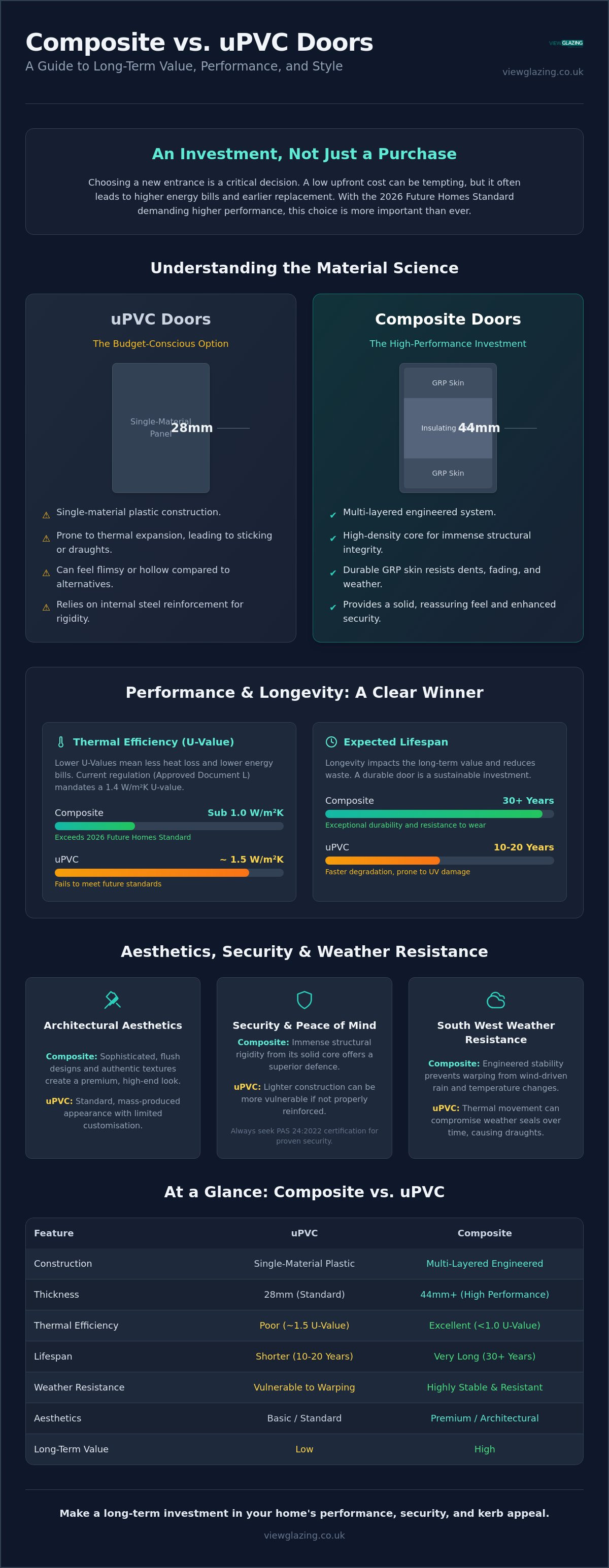
Whilst a door's essential and primary purpose remains unchanged since antiquity, the engineering that separates a standard plastic entrance from a modern composite system is profound. When evaluating composite vs upvc doors, the distinction lies in whether you prefer a singular, mass-produced commodity or a precision-engineered multi-material system. This choice dictates how your entrance will behave under the environmental stresses of the South West, where wind-driven rain and temperature shifts are constant factors.
The fundamental difference is found in the thickness and density of the door slab. A standard uPVC panel typically measures just 28mm, whereas a high-specification composite slab is 44mm thick. This extra depth isn't just for show; it provides a level of structural rigidity that plastic alone cannot match. This disparity in mass often explains why many homeowners describe uPVC as feeling flimsy or hollow when compared to the solid, reassuring thud of a composite alternative.
The Anatomy of a uPVC Entrance
uPVC, or Unplasticised Polyvinyl Chloride, is a lightweight plastic material that has served as the default choice for budget-conscious developers for decades. Because the material lacks inherent stiffness, these doors rely on internal steel reinforcement within the frame to maintain their shape. However, being a single-material construction, uPVC is susceptible to significant expansion and contraction during fluctuating temperatures. This thermal movement can lead to the door sticking in the height of summer or becoming draughty in the winter, as the plastic frame struggles to return to its original dimensions.
The Engineering Behind Composite Doors
Composite doors represent a shift toward architectural excellence by combining several materials to cancel out the weaknesses of each. The core is typically constructed from high-density insulating foam or solid timber, providing immense structural integrity and thermal resistance. This core is then encapsulated in a Glass Reinforced Plastic (GRP) skin, which is specifically designed to resist dents, scratches, and the bleaching effects of UV rays. Glass Reinforced Plastic is a high-performance material used in the construction of boat hulls for its extreme weather resistance and durability.
For those seeking a modern aesthetic, Flush Composite Entrance Doors utilise this multi-layered science to offer a sleek, flat finish that doesn't sacrifice performance for style. By bonding these disparate materials together, manufacturers create a door that remains perfectly aligned within its frame, regardless of the weather outside. This engineering ensures that the architectural vision for your property remains intact for decades, rather than just a few seasons.
Performance and Security: Why Construction Matters in the South West
Whilst the material science determines a door's potential, the South West climate provides the ultimate test. In coastal regions or exposed areas like the Cotswolds, damp air and high wind loads can cause inferior materials to bow or flex. A warped door creates gaps in the weather seals, leading to heat loss and compromised safety. When comparing composite vs upvc doors, the composite slab's multi-layered density remains remarkably stable, whilst uPVC panels are more prone to thermal movement that can disrupt the frame's alignment over time.
Thermal Insulation and Energy Bills
Energy performance is no longer just a preference; it's a regulatory necessity for 2026. Standard uPVC doors typically offer a U-value of around 1.5 W/m²K, which barely meets the minimum requirements for modern efficiency. In contrast, high-performance composite systems often achieve values sub-1.0 W/m²K. This superior insulation works most effectively when you adopt a whole-house approach, perhaps by pairing your entrance with VELFAC windows Bristol homeowners frequently choose for their own architectural projects. Robust weather seals are equally vital, ensuring that biting winds don't penetrate your living space during a harsh winter.
Security Standards and Peace of Mind
Security standards have evolved to combat more sophisticated entry methods, making PAS 24:2022 the essential benchmark for any new installation. These UK security performance requirements ensure the entire doorset, including the glass and hardware, can resist physical attack. Composite doors are inherently harder to breach because of their solid timber or foam core, whilst uPVC relies heavily on the strength of its internal steel reinforcement. Professional installation is the final piece of the puzzle. Even the most secure door will fail if the frame isn't perfectly plumb and the multi-point locking system isn't precisely calibrated to engage every hook and bolt.
Noise reduction is a frequently overlooked benefit of a denser construction. The solid core of a composite door naturally dampens the sound of traffic and wind, creating a more peaceful internal environment than a hollow uPVC alternative. If you're unsure which specification best suits your property's specific location, you can speak with our technical team for tailored advice on local weather performance and security ratings.
Architectural Aesthetics: Kerb Appeal and Style Versatility
The visual identity of your home begins at the threshold. Whilst previous sections explored the hidden engineering of composite vs upvc doors, the aesthetic impact is what defines your property's kerb appeal. For many homeowners, the primary drawback of uPVC remains its distinctive "plastic sheen." Even with modern woodgrain foils, uPVC can struggle to replicate the authentic depth and tactile quality of traditional timber. In contrast, composite doors utilise through-colour GRP skins that are moulded from real wood grain, providing a sophisticated texture that remains indistinguishable from natural oak or painted softwood.
In modern Bristolian architecture, we've seen a significant shift toward minimalist, flush designs. These entrances prioritise clean lines and recessed hardware, move away from the raised mouldings typical of 1990s uPVC styles. A flush composite entrance provides the structural mass required to support oversized modern handles and integrated glazing panels, creating a statement piece that feels permanent and intentional rather than a mere utility item.
Modern Minimalism vs Traditional Charm
Achieving a cohesive architectural vision requires every element of the building's envelope to work in harmony. Flush composite doors are particularly effective when you need to match the slim profiles of other high-end glazing systems. For instance, many clients choose to coordinate their front entrance with Cortizo sliding doors at the rear of the property, creating a consistent design language across the entire project. uPVC often lacks the structural strength to maintain these sharp, minimalist lines, especially when specified in the larger apertures common in contemporary extensions.
Colour Longevity and UV Resistance
The longevity of a door's finish is often dictated by how the material handles solar gain. Darker shades, such as the Anthracite Grey or deep blacks popular in the 2026 architectural palette, can pose challenges for singular materials. Dark uPVC doors are known to absorb significant heat, which can lead to expansion issues and eventually cause factory-sprayed coatings to peel or flake. To mitigate these risks, the BPF Code of Practice for uPVC doors outlines strict guidelines for handling and installation to ensure stability.
Composite doors bypass many of these thermal concerns through their multi-layered construction. Because the GRP skin is separate from the insulating core, it can expand and contract independently without affecting the door's operation. This allows for a much broader range of muted tones and RAL-matched finishes that stay vibrant for decades, ensuring your architectural vision remains as striking in year twenty as it was on the day of installation.
Evaluating the Long-Term Investment: Maintenance and Longevity
When assessing composite vs upvc doors, the most critical metric is not the initial invoice total, but the cost per year of service. A standard uPVC door often begins to show its age after 15 to 25 years, as the plastic can become brittle or discoloured under prolonged UV exposure. In contrast, a high-quality composite system is engineered for a lifespan exceeding 30 years, offering a level of permanence that matches the architectural integrity of a well-built home. This longevity ensures that the entrance remains a functional asset rather than a pending maintenance liability.
Maintenance requirements differ significantly between these two materials. uPVC often requires periodic mechanical adjustments to realign the frame as it settles or reacts to temperature fluctuations. Composite doors are largely "fit and forget" solutions. Beyond an occasional wipe with warm soapy water to remove surface grit, they require very little intervention to maintain their performance and appearance. This ease of care is particularly beneficial for homeowners who prioritise a high-end finish without the burden of constant upkeep.
Total Cost of Ownership
The lower initial cost of uPVC is frequently offset by shorter replacement cycles. If you replace a uPVC door twice in the time one composite door remains functional, the "budget" choice becomes the more expensive one over the long term. This is why professional glazing project management is essential for achieving a genuine return on investment. A managed approach ensures that the material specification matches the building's intended lifespan, preventing the need for premature remedial work or total replacements that disrupt the property's envelope.
Sustainability and Eco-Friendly Glazing
Sustainability in 2026 is defined by both the carbon footprint of manufacturing and the operational carbon saved over the product's life. Whilst uPVC is highly recyclable at its end-of-life in the UK, the production of virgin plastic remains an energy-intensive process. Composite doors offer a distinct environmental benefit through their exceptional thermal density. Their superior U-values significantly reduce long-term operational carbon by lowering the energy required to heat the home. Choosing a door that lasts three decades rather than fifteen also halves the environmental impact associated with manufacturing, transport, and installation cycles.
From a valuation perspective, a premium entrance door acts as a signal of quality to prospective buyers. It suggests that the property has been maintained to a high standard, which can positively impact resale value. If you are ready to invest in the long-term architectural value of your home, contact our specialist team to discuss your specific project requirements.
Selecting the Right Entrance: Specification for South West Homes
Selecting the final specification for your property requires a balance between architectural vision and practical necessity. Whilst the technical superiority of composite systems is evident in terms of longevity and thermal density, the final choice often rests on the specific function of the aperture. For homeowners and developers in the South West, the debate of composite vs upvc doors is best resolved by categorising the entrance based on its exposure to the elements and its frequency of use. A primary residence demands a different level of performance than a detached garage or a secondary utility entrance.
When to Choose uPVC
uPVC remains a practical and cost-effective solution for specific applications where high-end architectural aesthetics are less of a priority. Modern uPVC systems have improved significantly since the 1990s, featuring more robust multi-chambered profiles and improved weather gaskets that offer better performance than their predecessors. We typically recommend uPVC for the following scenarios:
Rental Properties: Where immediate capital expenditure is a primary concern and the typical 15-20 year lifespan is acceptable.
Outbuildings and Garages: Where the door provides secondary access and doesn't need to match the high thermal performance of the main house.
Strict Budget Constraints: For projects where the priority is a clean, functional entrance at the lowest possible price point.
However, we strongly advise against using low-grade uPVC for high-traffic main entrances. The singular material construction often leads to mechanical wear and alignment issues when subjected to the constant use typical of a family home.
The View Glazing Approach to Entrances
For primary residences and high-specification extensions, we advocate for the use of high-performance Flush Composite Entrance Doors. Our approach prioritises structural integrity and architectural harmony, ensuring your entrance functions as a seamless part of the building's envelope. The journey begins with a comprehensive technical survey. This stage is vital for identifying potential fitting issues, such as uneven masonry or drainage requirements, which are often overlooked in standard retail installations.
By conducting a precise survey, we ensure that every door installed in Bath or Bristol remains perfectly plumb and weather-tight for decades. This professional oversight prevents the common frustrations of sticking frames or whistling draughts. Integrating your door choice with a wider glazing strategy allows for a cohesive aesthetic. When the entrance door shares the same colour palette and design language as your windows and sliding doors, it elevates the entire property's character. This methodical specification process ensures that your investment provides both immediate kerb appeal and long-term peace of mind, reflecting a commitment to architectural excellence that lasts a lifetime.
Securing Your Architectural Vision for the Decade Ahead
As we navigate the evolving efficiency standards of 2026, the decision between composite vs upvc doors becomes a choice between a short-term utility and a permanent architectural investment. Whilst uPVC serves basic functional needs for outbuildings or rentals, the multi-layered engineering of a composite system provides the thermal stability and security required for modern primary residences. By prioritising a high-density core and a durable GRP skin, you ensure your home remains weather-tight, quiet, and aesthetically striking for over 30 years.
Our specialists focus on high-performance, architectural-grade glazing, providing expert project management across the South West. Whether you're coordinating a new entrance with VELFAC windows or Cortizo sliding systems, we ensure every detail aligns with your design goals. We're dedicated to helping you achieve a transformative impact through precision engineering and sophisticated design that stands the test of time.
Enquire about a professional entrance door installation today to begin your project with a comprehensive technical survey. We look forward to collaborating with you to create an entrance that perfectly balances lasting beauty with elite performance.
Frequently Asked Questions
Is a composite door worth the extra cost over uPVC?
Yes, the investment is justified by the significantly longer lifespan and superior thermal performance. Whilst uPVC is cheaper initially, a composite door typically lasts twice as long, which helps you avoid the disruption and expense of a second replacement. The enhanced kerb appeal and security also contribute positively to the property's overall market value and long-term architectural integrity.
Do composite doors warp in the sun like uPVC doors?
Composite doors are far more resistant to thermal expansion than singular uPVC panels. Because they use a multi-layered construction with a Glass Reinforced Plastic skin, they maintain their structural integrity even in direct sunlight. uPVC doors rely on a single material that expands more dramatically, which often leads to the sticking or bowing issues common in older plastic systems.
Which is more secure: a composite door or a uPVC door?
Composite doors are inherently more secure due to their solid timber or high-density foam core. This density makes them much harder to breach through physical force compared to the hollow, steel-reinforced profiles of uPVC. When comparing composite vs upvc doors, both should meet PAS 24:2022 standards, but the physical mass of a composite slab offers a higher level of natural resistance.
Can you paint a composite door if you want to change the colour?
You can paint a composite door, though it requires specific primers and paints designed for GRP surfaces. Most homeowners prefer the factory-applied through-colour finish because it's designed to be maintenance-free for decades. If you're planning a major change to your home's architectural palette, it's usually more effective to specify the correct RAL colour at the point of manufacture to ensure a permanent bond.
How long does a composite door last compared to uPVC?
A high-quality composite door is designed to last 30 years or more with minimal intervention. In contrast, uPVC doors typically have a service life of 15 to 25 years before the plastic begins to degrade or the mechanical seals fail. This makes the composite option a more sustainable and reliable choice for those looking for a permanent solution for their primary residence.
Are composite doors better for noise reduction in busy areas like Bristol?
Yes, the 44mm thickness of a composite slab provides significantly better acoustic insulation than a 28mm uPVC panel. The dense internal core acts as a natural sound barrier, which is particularly effective for homes near busy roads or in urban centres. This reduction in decibel transfer creates a much quieter and more tranquil internal environment for you and your family.
What is the difference in maintenance between the two materials?
uPVC doors often require periodic mechanical adjustments to keep the locking points aligned as the frame settles or reacts to heat. Composite doors are essentially "fit and forget" systems that only require an occasional wipe with warm soapy water to remove surface grit. They don't suffer from the same level of thermal movement, which means the hinges and locks stay aligned for longer.
Which door type is better for energy efficiency and lower U-values?
Composite doors are the superior choice for energy efficiency, frequently achieving U-values below 1.0 W/m²K. This performance is critical for meeting the 2026 Future Homes Standard targets. When evaluating composite vs upvc doors, the insulating foam or timber core of the composite version provides a much more effective thermal break than the air-filled chambers found inside standard uPVC frames.
Comments