.png)

Energy Efficient Windows Bath: The 2026 Architectural Guide to Thermal Performance

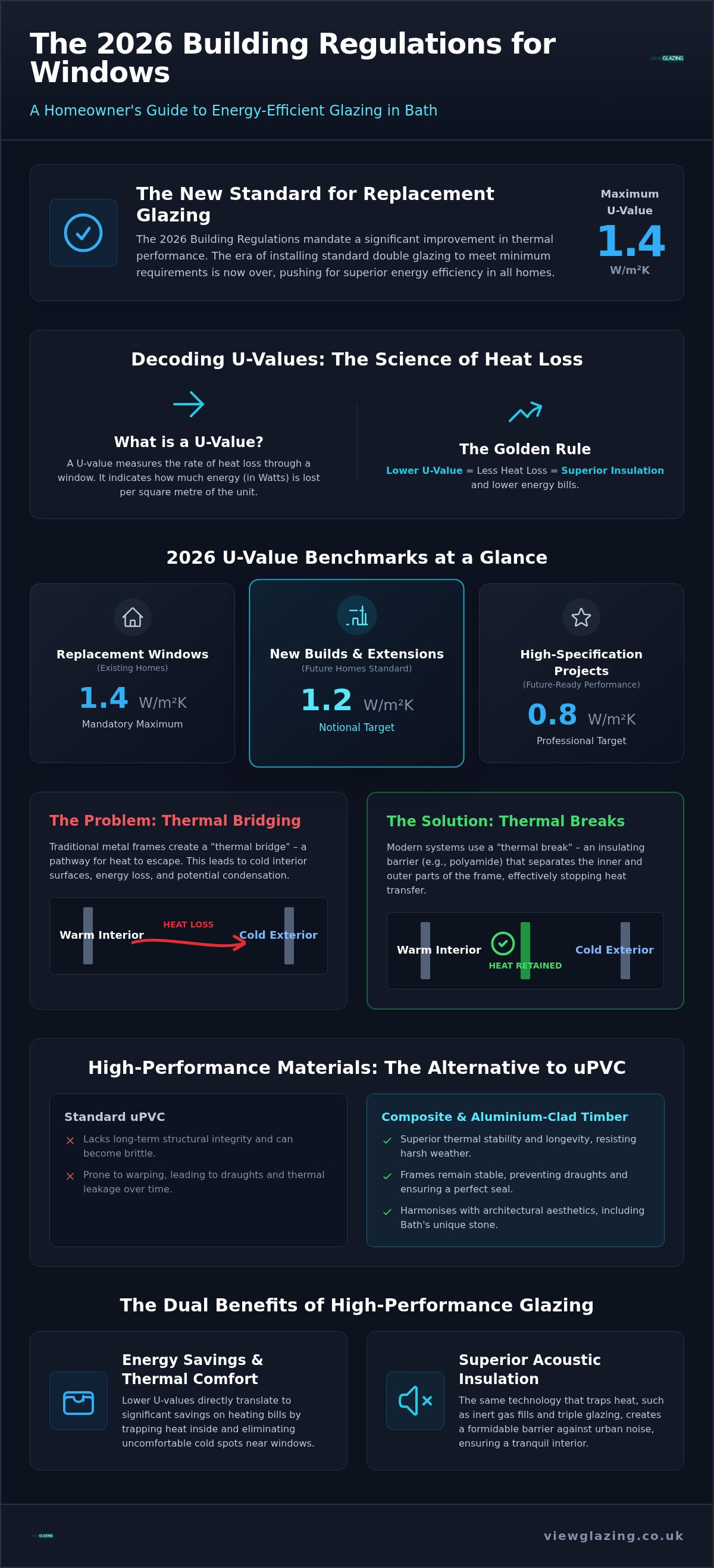
With the 2026 Building Regulations now mandating a maximum U-value of 1.4 W/m²K for replacement glazing, the era of simply choosing standard double glazing is over. For homeowners in Bath, this shift presents a unique challenge: upgrading draughty period properties without sacrificing the distinct architectural character of our historic city. You likely already know that traditional windows are often the weakest link in your home's thermal envelope, leading to escalating heating costs and uncomfortable cold spots. Selecting energy efficient windows Bath requires more than just meeting a legal minimum; it's about investing in a solution that complements Bath stone while delivering the performance of a modern sanctuary.
This guide clarifies the complexities of the 2026 standards and the Future Homes Standard, helping you move beyond the confusion of changing U-value targets. You'll discover how to optimise your Bath home’s thermal efficiency whilst enhancing its architectural aesthetic with high-performance glazing solutions like VELFAC composite and Rationel timber systems. We'll explore the technical nuances of whole-window performance, the growing shift towards triple glazing, and the precise installation methods required to ensure your property remains warm, quiet, and compliant for decades to come.
Table of Contents
Navigating Thermal Efficiency in Bath’s Unique Architectural Landscape
The Science of Performance: Decoding U-Values and Thermal Breaks
Composite and Timber: The High-Performance Alternative to uPVC
Precision Specification: Why Surveying is Critical for Thermal Integrity
Elevating Your Bath Property with View Glazing’s Architectural Excellence
Navigating Thermal Efficiency in Bath’s Unique Architectural Landscape
The definition of a high-performing home has evolved. In 2026, simply fitting standard double glazing no longer suffices to meet the UK’s stringent environmental targets. For those seeking energy efficient windows Bath offers a specific set of challenges. Our local maritime climate, characterised by high humidity and damp air from the Severn Estuary, places significant stress on building materials. While uPVC might seem like a quick fix, it often lacks the structural integrity required to withstand these conditions over decades. Choosing architectural-grade timber or composite systems ensures your frames remain stable, preventing the warping that leads to the draughts and thermal leakage that plague older properties.
Retrofitting Period Properties vs New Build Standards
Bath’s status as a UNESCO World Heritage site means thermal upgrades often clash with preservation orders. Achieving the 1.4 W/m²K requirement for replacement windows in a Georgian terrace requires a delicate touch. It's about finding systems that mimic traditional sightlines while delivering 21st-century performance. For modern developments across the South West, the goal is often even higher. Many new-build projects now target U-values as low as 0.8 W/m²K to future-proof against rising energy costs. A "whole-window" approach is vital here; the frame, glass, and seals must work in perfect unison to maintain the building’s thermal envelope and prevent the "performance gap" often seen in cheaper installations.
Acoustic Insulation: The Silent Benefit of Efficiency
Beyond heat retention, high-performance glazing addresses the persistent issue of urban noise. Central Bath’s stone-paved streets can act as echo chambers for traffic and footfall. Understanding The Science of Performance: Decoding U-Values reveals that the same technology used to trap heat, such as inert gas fills and varied glass thicknesses, also creates a formidable acoustic barrier. Triple glazing has become the professional choice for city-centre refurbishments precisely because it offers this dual benefit. By increasing the thermal mass of the window unit and utilising high-performance seals, you don't just lower your bills; you create a tranquil, silent interior. This level of specification is a critical investment for property value in the Cotswolds and surrounding areas, where buyers increasingly prioritise quiet, low-carbon living.
The Science of Performance: Decoding U-Values and Thermal Breaks
To truly understand how energy efficient windows Bath homeowners choose will impact their long-term comfort, we must look at the science of heat transfer. A U-value measures the rate of heat loss through a window; specifically, the amount of energy lost in Watts per square metre of the unit. While many suppliers focus solely on the glass, the frame's performance is equally critical. A low U-value indicates superior insulation, meaning your heating system doesn't have to work as hard to maintain a consistent temperature. In the context of 2026 standards, settling for the bare minimum can be a costly mistake, as even a small decimal improvement in U-value translates to significant savings on annual heating bills.
The primary enemy of efficiency is the "thermal bridge," a pathway that allows heat to escape through conductive materials. Traditional aluminium frames were notorious for this, but modern architectural systems solve the problem with thermal breaks. These are insulating barriers, often made of high-performance polyamide, that separate the inner and outer sections of the frame. By interrupting the flow of energy, these breaks ensure the interior surface of your window remains warm to the touch, even when the Bath winter is at its peak. This technology is vital for preventing the condensation and mould growth often associated with older, poorly insulated glazing.
U-Value Benchmarks for 2026 Building Regulations
Under the Building Regulations etc. (Amendment) (England) Regulations 2026, replacement windows in existing homes must now achieve a maximum U-value of 1.4 W/m²K. For new builds and major extensions, the notional target is 1.2 W/m²K, though many high-specification projects now aim for 0.8 W/m²K to meet future-ready standards. Systems from VELFAC and Rationel consistently outperform these legal minimums. By specifying windows that exceed current requirements, you aren't just complying with the law; you're creating a more resilient home. Investing in higher performance now provides a faster return on investment as energy prices fluctuate, making it a sound financial decision for any property owner.
Frame Material Comparison for Energy Efficiency
The choice of frame material dictates the window's overall thermal conductivity. Aluminium systems, such as those from Cortizo, offer slim, elegant profiles but rely heavily on advanced thermal breaks to manage heat loss. Timber is a naturally insulating material that sequesters carbon, making Rationel timber windows a favourite for sustainable South West builds. However, composite frames, like VELFAC, represent the current gold standard. By combining the external durability of aluminium with the natural warmth and insulation of an internal timber frame, composite systems provide a superior thermal barrier. To understand how these technical specifications translate to your specific project, you can speak with our technical team for a detailed consultation.
Composite and Timber: The High-Performance Alternative to uPVC
While many local suppliers advocate for uPVC as a budget-friendly option, it often fails to meet the long-term aesthetic and thermal demands of high-end South West properties. When selecting energy efficient windows Bath homeowners must consider a climate where durability is paramount. Aluminium-clad timber, or composite, has emerged as the gold standard for modern extensions because it balances high-performance insulation with architectural elegance. These systems offer a sophisticated profile that complements both contemporary designs and traditional Bath stone.
Unlike plastic, which can expand and contract significantly with temperature fluctuations, timber frames provide exceptional thermal stability. This resistance to movement ensures that high-performance seals remain intact, preventing the air leakage that degrades a building's thermal envelope over time. It is this structural integrity that makes composite systems the preferred choice for the energy efficient windows Bath developments require to meet the 2026 standards.
Beyond performance, the environmental impact is a major consideration for today's renovators. Choosing Rationel windows allows homeowners to utilise FSC-certified timber, a renewable resource that naturally sequesters carbon. When you consider that material costs for windows have risen by over 18% since 2021, investing in systems designed to last 40 to 50 years provides a far superior return on investment compared to uPVC units that may require replacement in half that time.
VELFAC: The Minimalist Choice for Thermal Integrity
VELFAC is synonymous with minimalist design, offering ultra-slim sightlines that maximise solar gain without compromising on insulation. These systems are engineered to prevent internal condensation by maintaining a consistent temperature across the frame profile. The VELFAC thermal barrier technology utilises a unique structural bond between the external aluminium sash and the internal timber frame to eliminate cold bridging. This technical precision makes VELFAC windows Bristol and Bath's premier choice for contemporary architectural projects where light and efficiency are equally valued.
Rationel: Heritage Aesthetics with 21st-Century Warmth
For properties in Frome, Bath, and the wider Wiltshire area, Rationel offers a bridge between heritage aesthetics and modern performance. These windows achieve exceptional airtightness ratings, ensuring a draught-free living environment even in exposed rural locations. By combining traditional joinery techniques with 21st-century glazing technology, they preserve the character of historic properties whilst meeting the rigorous energy targets of the 2026 Building Regulations. This approach ensures that eco-conscious homeowners don't have to choose between a sustainable build and a beautiful home.
Precision Specification: Why Surveying is Critical for Thermal Integrity
Even the highest-specification unit will fail to perform if the initial measurement is flawed. An accurate site survey serves as the foundation for any successful architectural project, ensuring that the finished product integrates seamlessly with the building’s structure. When specifying energy efficient windows Bath properties require a bespoke approach that accounts for structural tolerances and thermal bridging. Poorly surveyed openings lead to excessive use of expanding foam or oversized sealant joints, both of which create weak points in the thermal envelope. Professional glazing project management bridges the gap between design intent and physical reality, ensuring that every millimetre is accounted for before the manufacturing process begins.
Specifying the correct glass is equally vital. Modern units utilise Low-E (low emissivity) coatings to reflect heat back into the room, whilst argon-filled cavities provide a much denser barrier than standard air. These components work in tandem with the frame to ensure the entire aperture remains a robust part of your home's insulation strategy. Without this level of technical oversight, the "performance gap" between a window's theoretical U-value and its real-world efficiency can be significant.
Technical Specification and Solar Gain
Selecting the right glass involves balancing heat retention with solar management. The G-value of a window determines how much solar heat is transmitted through the pane, a critical factor for South-facing Bath homes where overheating can become an issue. Conversely, North-facing elevations benefit from higher solar gain to assist with passive heating. Warm edge spacers are now a non-negotiable component for modern architectural glazing; these non-conductive bars separate the glass panes and reduce the risk of perimeter condensation. This level of technical detail is particularly vital when specifying large-scale Cortizo sliding doors, where the expansive glass area must meet strict thermal targets without sacrificing slimline aesthetics.
Installation Standards in the South West
Precision-engineered fitting is what separates a standard replacement from a high-performance architectural installation. In the damp maritime climate of the South West, ensuring a completely airtight seal is essential to protect the building fabric. Our team focuses on eliminating the draughts that often undermine the theoretical U-values of even the best systems. Every installation is carried out to meet or exceed FENSA and Certass thermal standards, providing you with the necessary certification for building control compliance. By prioritising expert project delivery, we ensure that bespoke architectural systems perform exactly as specified on the technical drawings. If you're planning a renovation or new build, you can book a technical site survey with our specialist team to ensure your project’s thermal integrity.
Elevating Your Bath Property with View Glazing’s Architectural Excellence
The transition to 2026 standards represents a significant shift in how we approach the building envelope. It isn't just about basic compliance; it's about the long-term integrity and comfort of your home. View Glazing acts as a dedicated collaborator for homeowners and architects across Bath, Bristol, and the Cotswolds. Our commitment to sourcing world-class systems from VELFAC, Rationel, and Cortizo ensures that every project benefits from the highest levels of thermal performance and aesthetic precision. By focusing on these premium brands, we provide a permanent investment that far exceeds the lifespan and efficiency of standard alternatives.
Our ethos is built on the intersection of beauty and performance. We don't just supply products; we curate solutions that respect the architectural heritage of the South West whilst embracing environmental responsibility. This specialist approach is why we remain the trusted partner for those seeking high-performance energy efficient windows Bath. We understand that precision is the only way to bridge the gap between architectural vision and real-world efficiency.
Full-Service Project Management for Bath Homeowners
Navigating the technical requirements of modern glazing can be daunting for even the most experienced renovator. We remove this complexity by providing a comprehensive package that covers initial specification, technical sourcing, and precision installation. Our team of specialists is trained in the nuances of high-performance systems, ensuring that every seal and thermal break is perfectly aligned. This methodical process guarantees that the U-values specified in your design are actually achieved in your finished home. You can contact our team to discuss your energy-efficient project and begin the journey toward a more comfortable, sustainable property.
Realising Architectural Vision through Light and Efficiency
The most vital decision for any building envelope is the choice of glazing. It's the element that defines how you experience light and space whilst maintaining the thermal comfort of your interior. Our portfolio of successful projects across the South West demonstrates how bespoke architectural glazing can transform a living space into a tranquil, energy-efficient sanctuary. Whether you're retrofitting a period cottage or designing a contemporary masterpiece, we provide the technical skill and aesthetic vision required to realise your goals. By prioritising energy efficient windows Bath at the design stage, you ensure your home remains a testament to architectural excellence and environmental stewardship for decades to come.
Future-Proofing Your Home for 2026 and Beyond
The implementation of the 2026 Building Regulations marks a turning point for property owners in the South West. Meeting the new 1.4 W/m²K thermal targets requires a move away from generic replacements in favour of precision-engineered architectural systems. By prioritising a "whole-window" approach, you ensure your home remains draught-free and compliant whilst enhancing its unique character. Choosing energy efficient windows Bath homeowners can trust means investing in materials like composite and timber that offer superior longevity over standard plastic alternatives. These high-performance solutions don't just lower bills; they create a more tranquil, acoustically insulated environment.
As authorised VELFAC and Rationel installers, View Glazing provides a comprehensive survey and specification service designed to eliminate the performance gap. Our role as high-end architectural glazing specialists is to act as your steady guide through the complexities of modern thermal standards. We bridge the gap between technical requirement and aesthetic harmony, ensuring every installation is a permanent asset to your building envelope. Discuss your energy-efficient glazing project with our Bath experts today. We look forward to helping you transform your property into a high-performance sanctuary that stands the test of time.
Frequently Asked Questions
What is a good U-value for energy-efficient windows in 2026?
A good U-value for energy-efficient windows in 2026 should ideally surpass the legal minimums set by the latest Building Regulations. While the standard for replacement glazing is 1.4 W/m²K, aiming for 1.2 W/m²K or lower provides superior future-proofing for your home. High-performance systems, such as VELFAC composite units, often achieve values as low as 0.8 W/m²K. Selecting these lower values ensures your property remains thermally efficient as energy standards continue to tighten across the UK.
Is triple glazing worth the investment for a home in Bath?
Triple glazing is often a worthwhile investment for Bath properties, particularly those in exposed locations or busy urban centres. While it typically increases initial costs by 15% to 20% compared to double glazing, it offers a corresponding 15% to 20% improvement in thermal performance. This upgrade is especially beneficial for meeting the strict energy targets of modern new builds or achieving Passive House standards in the South West. It also significantly enhances acoustic insulation.
How do energy-efficient windows help reduce external traffic noise?
High-performance glazing reduces external traffic noise through a combination of increased glass mass and precision-engineered seals. By utilising varied glass thicknesses and inert gas fills, the energy efficient windows Bath residents choose can disrupt sound waves more effectively than standard units. This is particularly valuable for homes near busy city-centre streets or main arterial roads. The airtight construction required for thermal efficiency naturally creates a formidable barrier against intrusive urban noise, leading to a much quieter interior.
Can I install energy-efficient windows in a listed building in Bath?
Installing energy-efficient windows in listed buildings requires careful navigation of Bath’s strict planning and conservation rules. While standard double glazing is often prohibited in Grade I and II listed properties, slim-profile timber systems from brands like Rationel can sometimes be specified with heritage-appropriate detailing. It's essential to consult with a specialist surveyor and the local planning authority before commencing work. We focus on providing architectural solutions that balance heritage aesthetics with the best possible thermal performance.
What is the difference between double and triple glazing for heat loss?
The primary difference lies in the additional pane of glass and the second insulating cavity, which significantly slows the rate of heat transfer. High-performance double glazing typically achieves U-values around 1.2 to 1.4 W/m²K, whereas triple-glazed units can reach 0.8 W/m²K or lower. This extra layer of insulation reduces cold spots near windows and minimises internal condensation. For homeowners prioritising maximum energy retention and lower heating bills, the third pane provides a substantial and measurable thermal advantage.
How long do high-performance composite windows typically last?
High-performance composite windows are designed to last between 40 and 50 years, far outstripping the typical lifespan of uPVC. The external aluminium cladding protects the internal timber frame from the damp maritime climate of the South West, preventing rot and structural degradation. This durability ensures that the window’s thermal performance and airtight seals remain effective for decades. Investing in composite systems like VELFAC provides a long-term return on investment by reducing the frequency of costly replacements.
Do I need to replace my window frames to improve thermal efficiency?
Replacing the entire window unit is usually necessary to achieve true thermal efficiency. Simply upgrading the glass often fails to address the significant heat loss that occurs through old, poorly insulated frames or degraded seals. Modern energy efficient windows Bath homeowners select are engineered as a complete system where the frame and glass work in unison. Retaining old frames often leads to thermal bridging and air leakage, which undermines the benefits of high-specification glazing and prevents compliance.
Are timber windows as energy-efficient as aluminium or composite?
Timber is naturally one of the most energy-efficient materials available due to its low thermal conductivity. When properly specified, timber windows from Rationel can match or even exceed the performance of aluminium systems. Composite windows offer a unique advantage by combining the natural insulation of wood with the weather resistance of aluminium. While aluminium requires advanced thermal breaks to manage heat loss, all three materials can achieve exceptional U-values when specified as part of a high-performance architectural glazing solution.


Comments